A Pessimistic Colleague: So, what ya got goin' on in class today, tech guy? Me: Oh, just facilitating an awesome, 100%-engaged class discussion about rhetorical strategies found in famous speeches. A Pessimistic Colleague: (sarcastically) Oh my, doesn't that sound riveting! (sipping his coffee) 100% engagement? Uh huh. And how ya gonna do that? (taking another drink of coffee). Me: Simple. They'll use their smartphones to call each other in class. A Pessimistic Colleague: (spitting out a bit of coffee due to pure astonishment) What? Ah, so you're one of those, huh? You allow smartphones in your class? Nah, I don't know... that to me is ridiculous, don't ya think? Me: (slowly and deliberately sipping my coffee to maintain my composure and to combat the thick, negative, and accusatory tone) Well... not really (pause). Now, you allow a watch on your wrist, right? A Pessimistic Colleague: (glancing down at his silver Seiko) Yeah, but... Me: (interrupting) And a car on the road to get you to work? A Pessimistic Colleague: Ah, come on. That's not... Me: (with a slight smirk) That's not what? Fair? Kind of like prohibiting the appropriate use of a valuable educational tool? A Pessimistic Colleague: Well, students and their darned smartphones are ruining the classrooms...and education. (a sense of anger about to boil over) And, to be honest, teachers like you aren't helpin' the matter none. Me: No. (pause) No, sir. I disagree. Quite vehemently, I might add. But if you'll suspend any premeditated and erroneously conceived condemnations of smartphones, and the multitudes of talented students who own them, I'll explain. You'll see. It goes like this...

A Good Class Discussion Is Just a Phone Call Away/The Smartphone and the Seismograph
“A Good Class Discussion Is Just a Phone Call Away/The Smartphone and the Seismograph” (originally published here on GettingSmart on 11.19.2014)
A Pessimistic Colleague: So, what ya got goin' on in class today, tech guy? Me: Oh, just facilitating an awesome, 100%-engaged class discussion about rhetorical strategies found in famous speeches. A Pessimistic Colleague: (sarcastically) Oh my, doesn't that sound riveting! (sipping his coffee) 100% engagement? Uh huh. And how ya gonna do that? (taking another drink of coffee). Me: Simple. They'll use their smartphones to call each other in class. A Pessimistic Colleague: (spitting out a bit of coffee due to pure astonishment) What? Ah, so you're one of those, huh? You allow smartphones in your class? Nah, I don't know... that to me is ridiculous, don't ya think? Me: (slowly and deliberately sipping my coffee to maintain my composure and to combat the thick, negative, and accusatory tone) Well... not really (pause). Now, you allow a watch on your wrist, right? A Pessimistic Colleague: (glancing down at his silver Seiko) Yeah, but... Me: (interrupting) And a car on the road to get you to work? A Pessimistic Colleague: Ah, come on. That's not... Me: (with a slight smirk) That's not what? Fair? Kind of like prohibiting the appropriate use of a valuable educational tool? A Pessimistic Colleague: Well, students and their darned smartphones are ruining the classrooms...and education. (a sense of anger about to boil over) And, to be honest, teachers like you aren't helpin' the matter none. Me: No. (pause) No, sir. I disagree. Quite vehemently, I might add. But if you'll suspend any premeditated and erroneously conceived condemnations of smartphones, and the multitudes of talented students who own them, I'll explain. You'll see. It goes like this...
A Pessimistic Colleague: So, what ya got goin' on in class today, tech guy? Me: Oh, just facilitating an awesome, 100%-engaged class discussion about rhetorical strategies found in famous speeches. A Pessimistic Colleague: (sarcastically) Oh my, doesn't that sound riveting! (sipping his coffee) 100% engagement? Uh huh. And how ya gonna do that? (taking another drink of coffee). Me: Simple. They'll use their smartphones to call each other in class. A Pessimistic Colleague: (spitting out a bit of coffee due to pure astonishment) What? Ah, so you're one of those, huh? You allow smartphones in your class? Nah, I don't know... that to me is ridiculous, don't ya think? Me: (slowly and deliberately sipping my coffee to maintain my composure and to combat the thick, negative, and accusatory tone) Well... not really (pause). Now, you allow a watch on your wrist, right? A Pessimistic Colleague: (glancing down at his silver Seiko) Yeah, but... Me: (interrupting) And a car on the road to get you to work? A Pessimistic Colleague: Ah, come on. That's not... Me: (with a slight smirk) That's not what? Fair? Kind of like prohibiting the appropriate use of a valuable educational tool? A Pessimistic Colleague: Well, students and their darned smartphones are ruining the classrooms...and education. (a sense of anger about to boil over) And, to be honest, teachers like you aren't helpin' the matter none. Me: No. (pause) No, sir. I disagree. Quite vehemently, I might add. But if you'll suspend any premeditated and erroneously conceived condemnations of smartphones, and the multitudes of talented students who own them, I'll explain. You'll see. It goes like this...

The Perimeter, the Players, and the Offering
“The Perimeter, the Players, and the Offering” (originally published here on GettingSmart on 1.14.2014)
I can easily remember being a teenager and watching Don Mattingly execute a flawless swing to produce a one-hop double off the right-center field wall in Yankee Stadium or witnessing Magic Johnson pick an opposing player’s pocket just before leading a fast break down court and earning an assist with a no-look, out-of-this-world pass to a teammate. Plays like this always bolted me from my seat and outside as I tried my best to emulate the perfection I just viewed.
This same pattern applied to movies and books. I brought to life whatever I was studying. In fact, my best classes were the active ones. The ones where the entire class came together to enhance the overall understanding of the assigned lessons. Whether the teachers allowed collaboration, projects, or some type of competition to “spice up” the lessons, learning was so much easier with just a little bit of creativity injected into the standards.
I was recently reminded of this truth just after I assigned a collaborative, multi-media project for my American Literature students that will culminate in a shared Widbook e-book that incorporates a literary analysis, a video summary, and a symbolic picture. However, the students quickly informed me that the rigor and complexity of the assigned text would be alleviated with a whole-class, interactive learning structure that guides them through the literature as all students contribute to the overall knowledge.
Well, I agreed. My conversations with the students as I circulated the classroom revealed this truth. I looked over my fifty-plus learning structures to see which one fit best, and I discovered the need for a totally new structure, one that accommodated the literature and standards, the current students, and our classroom.
So, out of necessity, “The Perimeter, the Players, and the Offering” was born.
Here’s a run-down of this new interactive learning structure.
The Guidelines
Note: Teacher will guide teams through a segmented reading of the assigned literature. With each section read, the teacher will stop and give ample time to complete the following guidelines to ultimately enhance the comprehension of the studied literature. Timed rounds are suggested for organization, fairness, and fluidity of the lesson.- Teams consist of 3 or 4 students.
- Each team designates one member as the actor/actress, also known as the “Player.” This person sits on the inside of the perimeter. The players are available for improvisational acting when selected.
- The remaining team members sit on the outer edge of the perimeter. These students, as well as the designated player, determine whether they will choose acting, literary analysis, or digital challenge as one of their offerings to contribute to the overall understanding of the literature currently studied.
- Each team will select just one offering per round.
- Teams will nonverbally announce their offerings in the following ways: acting-stand as a team, literary analysis-model Rodin’s “The Thinker” statue, digital challenge-hold up illuminated smartphones
- Each of the 3 offerings must be selected before beginning another cycle of selections.
- To begin the interactive structure/gamified lesson, the teacher will initiate “The Perimeter, the Players, and the Offering” by rolling the dice for the first time.
- After the initial round, the team located nearest the last chosen team in a clockwise manner will roll the dice.
- Teams will honor their offerings as it relates to the assigned section of literature. (i.e. If a team is chosen who offered acting, that team’s chosen “Player” will select as many other players to help him/her with the next assignment from the Acting card. However, if a team is chosen who offered a literary analysis, that team will accomplish the next task from the Literary Analysis card.)
- On even rounds, the selected team will perform its duties and then select another team.

The Offering: Option #1

The Offering: Option #2
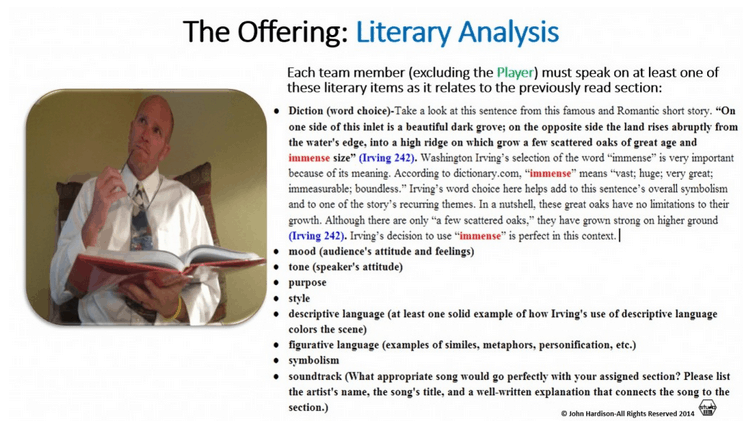
The Offering: Option #3
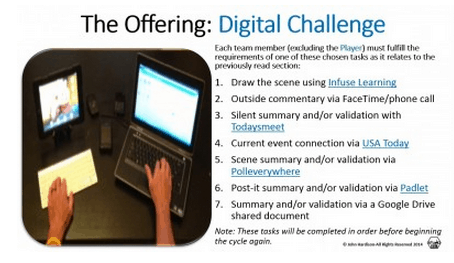
The Literary Revolver
“The Literary Revolver” (originally published here on GettingSmart on 10.11.2014)
Frankly speaking, interactive learning structures work. By merging standards-based prompts, random selectivity, a backchannel, improvisational acting, and overall creativity, Studio 113’s fairly new "Literary Revolver" places students on an engaging, challenging, and fun path to lesson mastery. Much like the “Voting Chips” and “Revolutionary Battle” structures that gamify lesson plans with out-of-the-box concepts, the “Literary Revolver” also injects a jolt of energy to any learning activity by gently tap-dancing on students’ nerves while maintaining a balance between unpredictability and rock-solid structure.
The Foundation
As with any good lesson plan, the standards and content come first. Then the question is: “How shall we explore and struggle with this lesson in a manner that promotes interest, forward thinking, and creativity?” Sometimes the answer provides our classroom learning community with a PBL solution, a personalized path, a somewhat traditional mode, or an interactive learning structure. To avoid any collegial accusations of hypocrisy, take a look below at the foundational prompts our students in Studio 113’s American Literature classes answered while participating in the “Literary Revolver.” In case you are wondering, this three-day lesson plan covered “Gate C22” from Ellen Bass, “Huswifery” from Edward Taylor, and “To My Dear and Loving Husband” by Anne Bradstreet.The Video Tutorials
Let’s be honest. Sometimes we are just like our students. When words do nothing but muddy or convolute our attempts to understand, video tutorials work perfectly. Here are two fairly precise explanations of the Literary Revolver and a graphic of the structure.[youtube http://youtu.be/pnv9T060cQE]
[youtube http://youtu.be/FkoBRI4J-Vs]
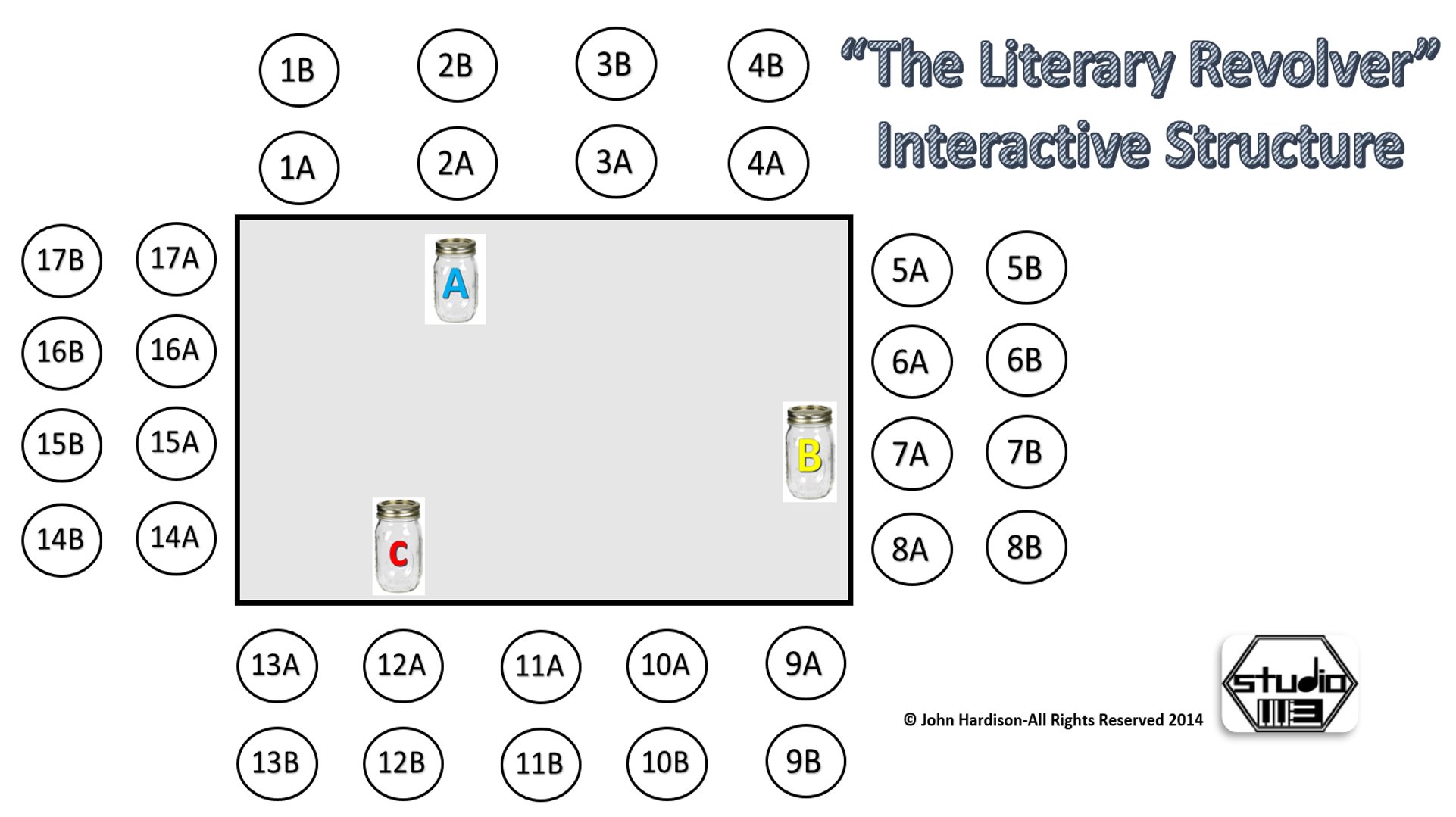
Classroom Examples
More in-action video examples of the “Literary Revolver” are in the works. Take a look at a few recent clips and some older clips from Studio 113. Sure. The examples here are from a Language Arts classroom. But can’t you imagine a “Math Revolver,” a “Science Revolver,” a "History Revolver," and a “_____________ Revolver”? Hey, you never know how cool it can be…unless you take a shot.Bringing Literature to Life Can Be Square
“Bringing Literature to Life Can Be Square” (originally published here on GettingSmart on 12.17.2014)
Literature is meant to be brought to life. Without musical, artistic, acting, and verbal connections, many students view literature as an endless flipping of pages full of meaningless words. They long to experience novels, short stories, poetry and other works of literary art by creating songs, drawing precise symbols, morphing into a character and dropping a few lines, and speaking in such an academic manner that demands the attention of their peers. Anything else can be, well, square.
How "The Square" Works
Musical Examples from "The Square"
Artistic Examples from "The Square"
Acting Examples from "The Square"
Speaking Examples from "The Square"
Preparation Time for "The Square"
90-Second Summary/Literature on a Football Field"
“90-Second Summary/Literature on a Football Field” (originally published here on GettingSmart on 8.24.2016)
I’ve always been fascinated by behind-the-scenes documentaries. Whether it’s a captivating musician on VH1’s Behind the Music, an eternal sport with Ken Burns’ Baseball, or some commonly used gadget on the Science Channel’s How It’s Made, I am constantly amazed by the underlying complexity of greatness. Take, for example, the iconic symbol in Forrest Gump…a meandering feather. Unless you watched this three-minute documentary, you would never imagine that something so seemingly simple demanded countless hours of digital rendering and choreographed acting. And this same attention to detail is precisely why the “90-Second Summary” is such an effective classroom assignment. The assignment goes something like this: After studying John Steinbeck’s Of Mice and Men through whole-class interactive learning structures and improvisational acting, I ask students for volunteer team leaders. For this particular literature, teams of 12-15 are just about perfect. Once the leaders have stepped forth, they both draft their teammates in an organized and anonymous fashion. Once the teams have been announced, the students get to work on the following assignment details:
Although the assignment may not seem daunting on paper, believe me, it is an arduous task for teams consisting entirely of energetic, talkative and headstrong students. Ultimately, the students must gel together to determine ways to organize their brilliant ideas, to assign team roles and to produce a polished product that exemplifies clarity, creativity and cohesive literary themes.
Take a look at our students' products for yourself. Surely you can spare 90 seconds.
Just remember, you will have to decide if you see greatness. However, if a behind-the-scenes documentary of this assignment were filmed, it would undoubtedly reveal detail and rigor.
I even extended the offer to Ken Burns. Let's hope he returns my call with a favorable answer.
For more, see:
Stay in-the-know with all things EdTech and innovations in learning by signing up to receive the weekly Smart Update.
I’ve always been fascinated by behind-the-scenes documentaries. Whether it’s a captivating musician on VH1’s Behind the Music, an eternal sport with Ken Burns’ Baseball, or some commonly used gadget on the Science Channel’s How It’s Made, I am constantly amazed by the underlying complexity of greatness. Take, for example, the iconic symbol in Forrest Gump…a meandering feather. Unless you watched this three-minute documentary, you would never imagine that something so seemingly simple demanded countless hours of digital rendering and choreographed acting. And this same attention to detail is precisely why the “90-Second Summary” is such an effective classroom assignment. The assignment goes something like this: After studying John Steinbeck’s Of Mice and Men through whole-class interactive learning structures and improvisational acting, I ask students for volunteer team leaders. For this particular literature, teams of 12-15 are just about perfect. Once the leaders have stepped forth, they both draft their teammates in an organized and anonymous fashion. Once the teams have been announced, the students get to work on the following assignment details:
- Ahh Yeah! The Slow Jams Are Back
- Drop the Syllabus for a “No-Dis Day” on Day One
- Do You Know Me? The Voice of a Disgruntled Student in a Boring Class
Stay in-the-know with all things EdTech and innovations in learning by signing up to receive the weekly Smart Update.
Drop the Syllabus for No Dis Day on Day One"
“Drop the Syllabus for a No Dis Day on Day One” (first published here on GettingSmart on 7.27.2016)
You know what I am talking about. That “hand-out-the-syllabus, set-the-tone, and establish-all-rules” practice that more than likely catapults students into a coma-like state of boredom and renders them disengaged, disillusioned and disconcerted. Yep, I guess it’s safe to say that students are “dissed” at the end of this type of first day of school. Heck, the facts are right there on social media, too. Sure enough, two years ago, I waited until the end of the first day of school to check my Studio 113 Twitter account. While perusing the new followers, I stumbled on a hashtag that contained students’ opinions about all of their classes from day one. To say the least, it was a “no-holds-barred” forum. Students were openly discussing the pros and cons of all their classes and, quite honestly, the comments weren’t too optimistic. In fact, probably 90% of what I read was flat out negative. They were even sharing predictions of which classes would be positively unique and which ones would be a waste of their time. I was mesmerized by their postings. Now, before you throw the book at me, I must admit that I subscribe to a belief that a solid classroom foundation begins with clear expectations, mutual respect, a positive tone, and efficient and necessary procedures and guidelines. For the last 18 years (and as long as I continue teaching), I have merged some of Harry Wong’s concepts with my own in order to establish a creative, collaborative and caring learning environment that students would never forget. By blending curriculum, interactive learning structures, collaborative assignments, and improvisational acting with the implementation of classroom procedures and guidelines, the students are introduced to the vision that drives Studio 113. In essence, these first 4-5 days are what we call “Training Camp.” However, if I am truly being transparent, I must admit that many of my first days have been too sedentary. If I would have checked Twitter on day one years ago, I may have discovered students who were disconnected, disheartened and just flat-out displeased. And, Lord knows I don’t want a student like Student X writing about me. No, sir. No, ma’am. So, what was my solution last year? Well, I asked the students to speak…without saying a word. Yep. You got it. I asked them to use our “Wax Museum” structure to answer two thought-provoking questions:
For more, see:
Stay in-the-know with all things EdTech and innovations in learning by signing up to receive the weekly Smart Update.
You know what I am talking about. That “hand-out-the-syllabus, set-the-tone, and establish-all-rules” practice that more than likely catapults students into a coma-like state of boredom and renders them disengaged, disillusioned and disconcerted. Yep, I guess it’s safe to say that students are “dissed” at the end of this type of first day of school. Heck, the facts are right there on social media, too. Sure enough, two years ago, I waited until the end of the first day of school to check my Studio 113 Twitter account. While perusing the new followers, I stumbled on a hashtag that contained students’ opinions about all of their classes from day one. To say the least, it was a “no-holds-barred” forum. Students were openly discussing the pros and cons of all their classes and, quite honestly, the comments weren’t too optimistic. In fact, probably 90% of what I read was flat out negative. They were even sharing predictions of which classes would be positively unique and which ones would be a waste of their time. I was mesmerized by their postings. Now, before you throw the book at me, I must admit that I subscribe to a belief that a solid classroom foundation begins with clear expectations, mutual respect, a positive tone, and efficient and necessary procedures and guidelines. For the last 18 years (and as long as I continue teaching), I have merged some of Harry Wong’s concepts with my own in order to establish a creative, collaborative and caring learning environment that students would never forget. By blending curriculum, interactive learning structures, collaborative assignments, and improvisational acting with the implementation of classroom procedures and guidelines, the students are introduced to the vision that drives Studio 113. In essence, these first 4-5 days are what we call “Training Camp.” However, if I am truly being transparent, I must admit that many of my first days have been too sedentary. If I would have checked Twitter on day one years ago, I may have discovered students who were disconnected, disheartened and just flat-out displeased. And, Lord knows I don’t want a student like Student X writing about me. No, sir. No, ma’am. So, what was my solution last year? Well, I asked the students to speak…without saying a word. Yep. You got it. I asked them to use our “Wax Museum” structure to answer two thought-provoking questions:
- What kind of class do you want to create this school year?
- What needs to change in some of today's classrooms?
- Explain the reason for the thematic song that played as students entered the class. Last year’s thematic song was “Am I Wrong?” by Nico and Vinz (5 minutes).
- Introduce myself and establish rudimentary classroom procedures (i.e. whole class discussion procedures, the traffic light system for technology integration and BYOD; 5 minutes).
- Clarify the vision behind our interactive Language Arts classroom, Studio 113 (5 minutes).
- Present guidelines and essential questions for a successful “Wax Museum” structure (5 minutes).
- Assign teams and allow brainstorming (15 minutes).
- Encourage students to start preparing for their silent pose (Note: students may use classroom-appropriate items from their personal belongings and/or our classroom as props; 5-7 minutes).
- Freeze and be silent…students “answer” the assigned questions via the “Wax Museum” (remaining time).
- Do You Know Me? The Voice of a Disgruntled Student in a Boring Class
- Want Student Engagement? Stage It and Set the Hook
- The Front Porch: A Rockin’ Interactive Structure
Stay in-the-know with all things EdTech and innovations in learning by signing up to receive the weekly Smart Update.
The Front Porch: A Rockin' Interactive Learning Structure
“The Front Porch” (first published here on GettingSmart on 9.10.2015)
There is so much about a comfortable front porch that is absolutely irresistible. The smooth, back-and-forth creaking of wooden rocking chairs. The rhythmic and melodic squeaks of a hanging porch swing. The clanking of ice against a glass of sweet tea that is topped off with a wedge of lemon. The sounds of a lazy afternoon highlighted by a gentle mixture of leisurely neighborhood activities and the busy-ness of nature. And, without a doubt, the most important sound of all… A fluid, relaxed, and honest conversation. Assuming the above comments are indeed true of the quintessential, down home front porch, shouldn’t the same sounds be heard from the front porch of, say, a classroom? Exactly. Introducing Studio 113’s “The Front Porch,” an interactive structure that is discussion-based learning where improvisational acting meets a flowing and focused conversation. On this front porch, you will be sure to hear the sounds of excellent character entrances, revealed student talent, relative current events, and thematic discourse. Yep. Just lend your ears to sounds as sweet as Southern iced tea. So, step on up to the front porch and sit a spell. A great conversation awaits.
There is so much about a comfortable front porch that is absolutely irresistible. The smooth, back-and-forth creaking of wooden rocking chairs. The rhythmic and melodic squeaks of a hanging porch swing. The clanking of ice against a glass of sweet tea that is topped off with a wedge of lemon. The sounds of a lazy afternoon highlighted by a gentle mixture of leisurely neighborhood activities and the busy-ness of nature. And, without a doubt, the most important sound of all… A fluid, relaxed, and honest conversation. Assuming the above comments are indeed true of the quintessential, down home front porch, shouldn’t the same sounds be heard from the front porch of, say, a classroom? Exactly. Introducing Studio 113’s “The Front Porch,” an interactive structure that is discussion-based learning where improvisational acting meets a flowing and focused conversation. On this front porch, you will be sure to hear the sounds of excellent character entrances, revealed student talent, relative current events, and thematic discourse. Yep. Just lend your ears to sounds as sweet as Southern iced tea. So, step on up to the front porch and sit a spell. A great conversation awaits.
Subscribe to:
Posts (Atom)